This collection brings together the fundamental scientific works authored by our team over decades of research. These monographs document the development of our core technologies — from theoretical foundations to field-validated applications. Each book represents a milestone in advancing chemical EOR and conformance control, serving as essential reading for researchers and engineers alike.

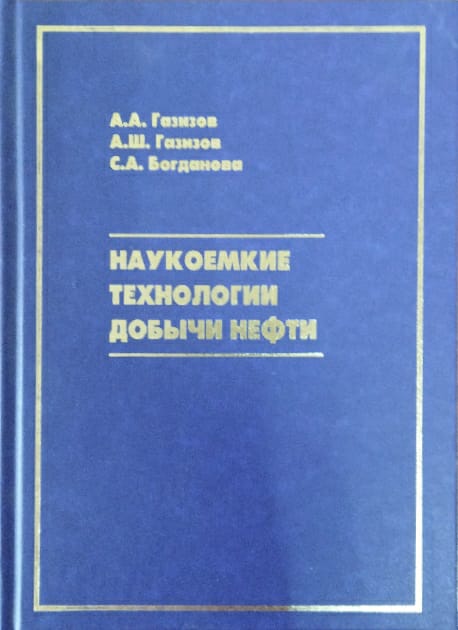
A. A. Gazizov, A. Sh. Gazizov, S. A. Bogdanova. Science-Intensive Oil Production Technologies / Kazan, Center of Innovative Technologies, 2014
Reviewer: R. Kh. Muslimov — Chairman of the Scientific Council on Geology and Development of Oil Fields under the Presidium of the Academy of Sciences of the Republic of Tatarstan, Academician of the Academy of Sciences of the Republic of Tatarstan and the Russian Academy of Natural Sciences, Doctor of Geological and Mineralogical Sciences, Professor at Kazan Federal University.
An analysis of the main causes of well water encroachment at late stages of development is given, and modern methods of increasing waterflood coverage to enhance ultimate oil recovery are considered. The prospects of using ionogenic polymers for selective limitation of mineralized water inflow are substantiated. Ion exchange processes in the systems “ionogenic polymer-mineralized formation water” and “polymer-electrolyte” were experimentally studied, and the influence of the reverse osmosis effect on restricting the movement of mineralized waters in the reservoir was examined. The stages of formation of polymer-dispersed systems during flocculation of dispersed particles by hydrolyzed polyacrylamide are described and experimentally investigated. The results of mathematical modeling of the studied processes are presented. Methods and results of field trials of the Polymer-Dispersed Systems (PDS) technology are given.

A. A. Gazizov, A. Sh. Gazizov, M. M. Kabirow, R. G. Khannanov. Intensification of Oil Production in Complicated Conditions / Kazan, Center of Innovative Technologies, 2008
The monograph analyzes the reasons for the decline in productivity of producing wells. The influence of the wettability of rock surfaces by reservoir fluids on the oil flow rate of wells is studied. The possibility of selective treatment of low-permeability interlayers with high residual oil saturation is demonstrated. The results of extensive application of well treatments with hydrophobizing compositions of RMD chemical reagents and other physicochemical methods are presented.

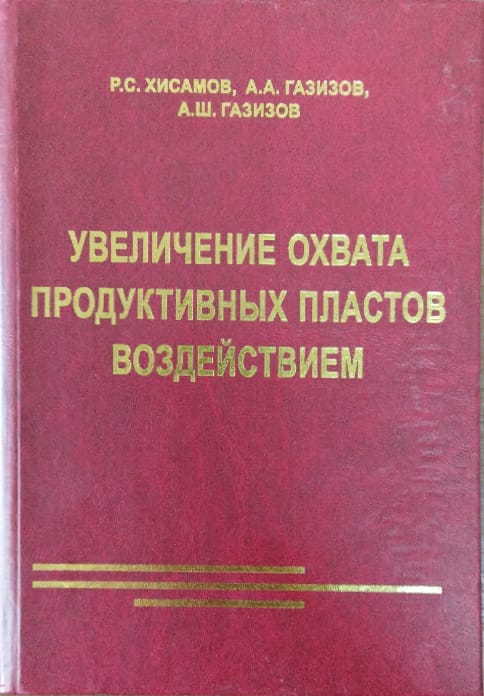
R. G. Hisamov, A. A. Gazizov, A. Sh. Gazizov. Increasing Reservoir Sweep Efficiency / Moscow: VNIIOENG, 2005
Reviewer: V.E. Gavura — Doctor of Geological and Mineralogical Sciences, Academician of the Academy of Mining Sciences
The book examines the influence of the heterogeneous structure of an oil reservoir on its waterflood coverage and possible ways to improve it. The results of theoretical, laboratory, and field studies on increasing reservoir sweep efficiency using hydrodynamic, physicochemical, physical, microbiological, and other enhanced oil recovery (EOR) methods are presented. The prospects for improving waterflooding through the application of EOR methods based on increasing the filtration resistance of flushed zones in an oil- and water-saturated reservoir are substantiated.

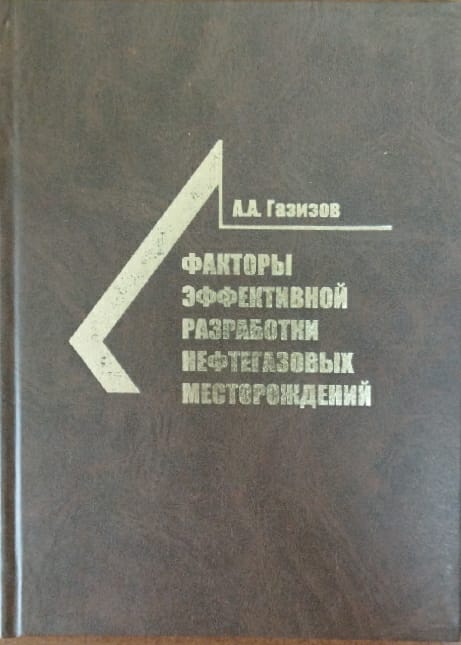
A. A. Gazizov. Factors for Effective Development of Oil and Gas Fields / Kazan, Center of Innovative Technologies, 2012
A description and classification of heterogeneities in the structure of oil deposits are provided, along with an analysis and quantitative assessment of the main elements of the classification. The influence of oil-water zones, composition, and properties of reservoir fluids on the degree of heterogeneity is considered. Approaches to using system-structure analysis and methods of mathematical statistics in assessing the heterogeneity of oil deposit structures are described. An analysis of actual data on the impact of heterogeneities on field development processes is carried out. Modern physicochemical, hydrodynamic, wave, and microbiological methods for treating heterogeneous reservoirs and the results of their application are presented.

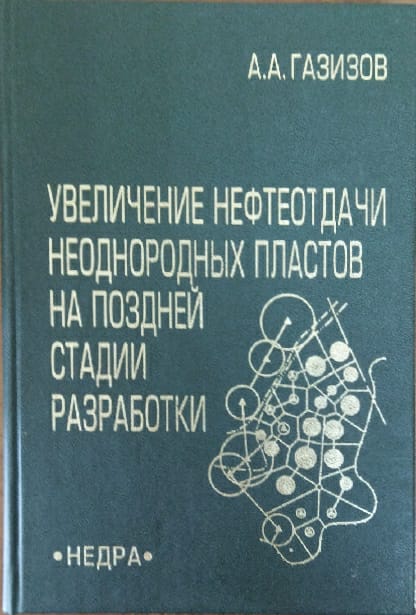
A. A. Gazizov. Enhanced Oil Recovery in Heterogeneous Reservoirs at Late Stage of Development / Moscow: Nedra, 2002
The role of the heterogeneous structure of oil deposits in the formation of residual oil during waterflooding is considered, and possible ways to recover it are shown. The results of theoretical, laboratory, and field studies on the effectiveness of increasing the ultimate oil recovery of heterogeneous reservoirs through the use of polymer-dispersed systems (PDS), modified polymer-dispersed systems (MPDS), as well as various compositions based on aluminum chloride and other chemical reagents are presented.

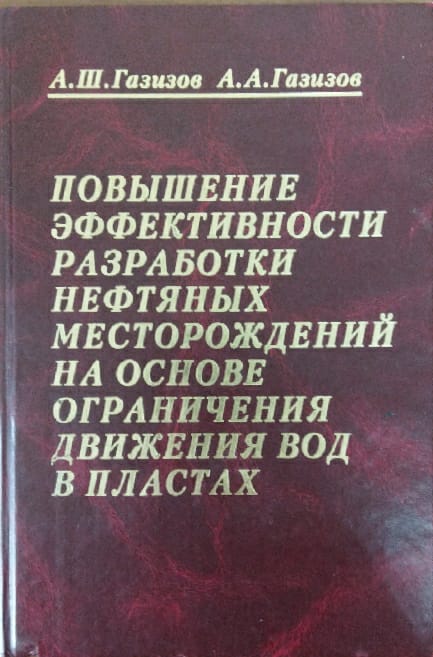
A. Sh. Gazizov, A. A. Gazizov. Improving the Efficiency of Oil Field Development Based on Restricting Water Movement in Reservoirs / Moscow: Nedra, 1999
The factors causing premature water encroachment of productive formations and wells during waterflooding of multi-zone oil fields are analyzed. Methods for restricting water movement and increasing the sweep efficiency of layered heterogeneous reservoirs are considered. The physicochemical foundations of using water shutoff materials in oil- and water-saturated reservoirs are outlined. The prospects of a method for regulating reservoir waterflooding by altering the filtration resistance of water-flooded zones using water shutoff materials are substantiated.